The Five Levels of AI Leverage
Most developers using AI are leaving 90% of it on the table.
Not because they lack the skill or curiosity. Because the bigger unlock isn't a new tool — it's a new way of working. And that shift takes intention, not just installation.
There's a stack of leverage available — five distinct levels, each one compounding the last. Most engineers have reached Level 3. A few are pushing into Level 4. Almost nobody is operating at the top.
Here's the full map.
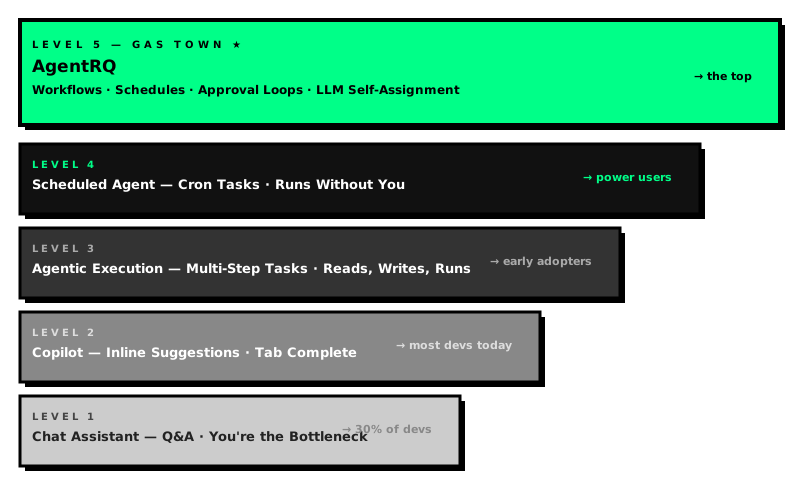
Level 1: AI as Answer Machine
You open a chat window. You ask a question. You get an answer.
This is where most people start, and where many stay. AI as a smarter search engine. A better Stack Overflow. A rubber duck that actually talks back.
The leverage here is real but limited: you're faster at finding answers, but you're still doing all the work. Every output requires you to read it, evaluate it, and act on it manually. The AI is a consultant you hire by the message.
Useful. But you're still the bottleneck.
Level 2: AI as Copilot
You're writing code, and suggestions appear inline. You tab-complete a function. You highlight a block and say "refactor this." The AI works alongside you, in your editor, in real time.
This is where many developers were a year ago. The leverage is meaningful — you ship faster, you make fewer typos, you get unstuck more quickly. Studies put the productivity gain somewhere between 30% and 55%.
But the AI still can't do anything you haven't explicitly asked for. It's reactive. You drive; it steers. The moment you close the editor, the work stops.
You've accelerated yourself. You haven't scaled yourself.
Level 3: AI as Agent
This is where the model changes. Instead of responding to your keystrokes, the AI executes multi-step tasks autonomously. You describe what you want; it reads files, runs commands, writes code, fixes errors, and reports back.
Claude Code is the clearest example. You give it a task — "add pagination to the blog index, update the sitemap, rebuild CSS" — and it does it. End to end. You come back to a diff.
The leverage jumps. You're no longer trading time for output; you're delegating work. One person can now direct a volume of work that would have taken a team.
But there's a catch: the agent only works when you're there to direct it. You wake up in the morning and nothing happened overnight. The potential is enormous, but it's still waiting for you to show up.
This is the ceiling most teams hit. They treat agentic AI as a very fast junior developer. That's not wrong — it's just not the top of the stack.
Level 4: AI on a Schedule
You stop directing the agent manually. Instead, you set up scheduled workflows — recurring tasks that fire automatically, without you initiating them.
Every morning at 6am: check for new competitor releases and draft a summary. Every Sunday: audit the site for broken links and missing meta tags. On every code push: run the full linter, flag anything that fails.
The agent shows up for work whether you do or not. You're no longer the trigger — the clock is.
This compounds Level 3 dramatically. You've gone from "I can direct a lot of work" to "work happens continuously, at volume, even while I sleep." The output-per-hour of your personal time has decoupled from the output-per-hour of the system.
But Level 4 still has a problem. Fully autonomous AI making decisions without oversight is a risk most people — and most organizations — can't accept. And rightly so. Some decisions require a human. The question is how to keep the human in the loop without making them the bottleneck.
Level 5: Autonomous Loops with Human Oversight
This is the top of the stack. And this is what AgentRQ is built for.
Level 5 isn't just AI on a schedule. It's AI in a workflow — a structured loop where the agent works autonomously until it hits a decision point, then surfaces the decision to you, waits for your input, and keeps going.
Here's what that looks like in practice:
- → The cold outreach workspace identifies three strong prospects, drafts personalized messages, and queues them for your approval. You review from your phone in two minutes. The approved ones go out. The rest get refined.
- → The coding workspace hits an architectural decision — "refactor or ship as-is?" — and creates an AgentRQ task: "I'm paused on this. Here's the tradeoff. What do you want to do?" You reply. It ships.
- → The agent tries to run a command that requires elevated permissions. Instead of failing silently or proceeding unsafely, it sends an approval request to your phone. You tap allow. It runs.
- → A scheduled research scan surfaces something worth addressing. The agent doesn't just flag it — it drafts a response, creates a task with the draft attached, and assigns it to itself with a "pending your review" status. You approve it. It executes.
This last pattern — LLM self-task assignment — is what separates Level 5 from everything below it. The agent isn't just executing tasks you define. It's identifying work, scoping it, assigning it to itself, and doing it — with you as the approver, not the initiator.
The human is still in the loop. But the loop no longer depends on the human to start.
Why Most Teams Stop at Level 3
The jump from Level 2 to Level 3 requires changing how you work, not just what tools you use. You have to learn to delegate to an AI, which means writing clear briefs, setting context, and accepting imperfect first drafts.
The jump from Level 3 to Level 4 requires trusting the agent to work without you watching. That takes time and confidence, built up from smaller wins.
The jump from Level 4 to Level 5 requires infrastructure: a way to get notified when the agent needs you, a way to respond from wherever you are, and a structured protocol for approvals and self-assignment. That's not something you build into your editor. It's a layer on top of the agent.
AgentRQ is that layer. It connects Claude Code to you via MCP — so the agent can surface decisions, request approvals, assign tasks to itself, and keep working the moment you respond.
The result: a system that runs at Level 5 continuously, with your judgment applied exactly where it matters and nowhere else.
The Stack Is Available Now
These aren't future capabilities. Every level on this stack is available today.
Most engineers are already at Level 3. The ones pushing to Level 5 — building structured workflows with human approval loops and LLM self-task assignment — are operating at a fundamentally different scale.
The gap between Level 3 and Level 5 isn't technology. It's architecture.
Get started with AgentRQ and connect Claude Code to the top of the stack.