Working with Claude Code Channels in Production More Than 6 Months
AgentRQ has supported Claude Code Channels in production for more than six months. Every task you create on the task board can reach a running Claude Code session as a channel message, and Claude answers back through the same channel.
That is long enough to know where Channels shine and where they get in the way. This post is the honest version: what works well, the pitfalls we hit again and again, and how we get the best of both worlds by pairing Channels with ACP and terminal access.
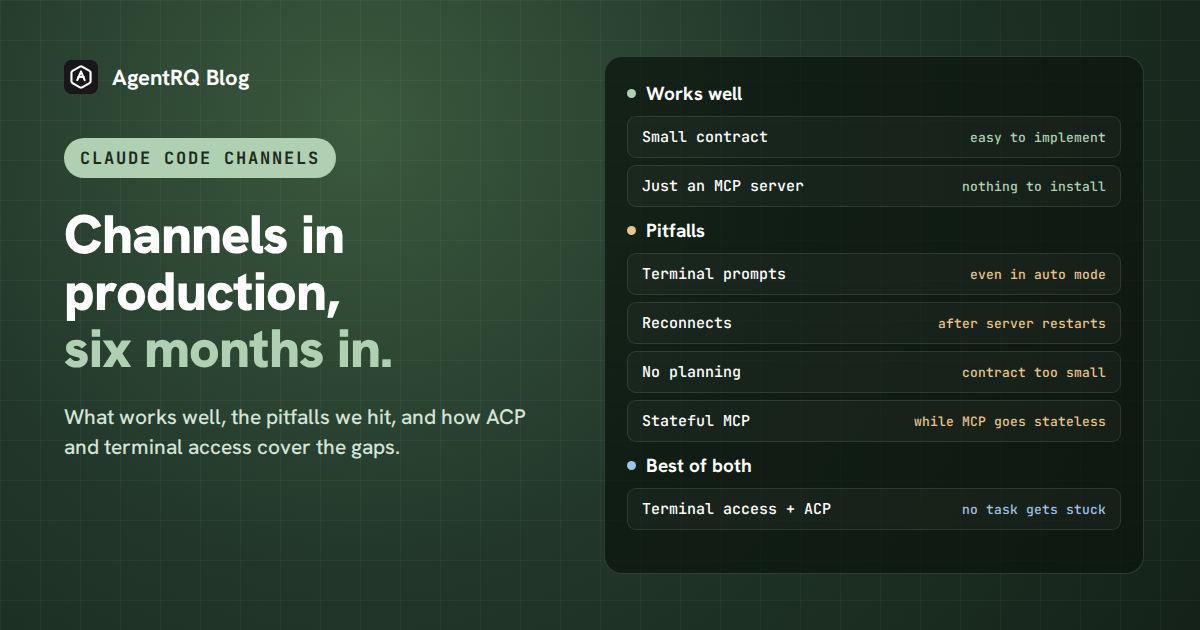
What Works Well
A small contract that is easy to understand
A channel is an MCP server that declares one capability and sends one kind of notification. If it wants answers back, it exposes a reply tool. That is close to the whole contract.
Compared with ACP (Agent Client Protocol), which covers sessions, prompts, tool calls, file access, terminals, plans and modes, Channels take an afternoon to understand and a day to implement. Our first working version was a few dozen lines. When something goes wrong, there are only a few places to look.
It is just an MCP server
Users do not install anything new. There is no adapter, no extra binary, no separate process to keep alive. Claude Code already speaks MCP, so connecting it to AgentRQ is one entry in the MCP config and a flag on start. See Connect Claude Code for the exact steps.
That matters more than it sounds. Every extra install step loses people, and with Channels there is almost nothing to install.
The Pitfalls
Auto mode still asks for commands in the terminal
In auto mode, Claude Code still stops from time to time and asks you to approve or type a specific command in the terminal. A message arriving over the channel does not change that. The task is waiting, the agent is waiting, and the only way forward is a keyboard in front of that terminal.
If you started the session on a server or another machine, that is exactly where you are not.
The channel is a side channel, not the main interface
Claude treats a channel as a channel: a source of incoming events. It does not treat it as the first-class interface the human is using. So it asks you to confirm things in the Claude Code terminal now and then, even though you sent the task, and are reading the replies, somewhere else.
Permission relay helps with tool approvals, but not every question goes through it. Some still land only in the terminal.
MCP connectivity after server restarts
When the MCP server restarts, for a deploy or a crash, Claude Code does not always reconnect the channel by itself. The session keeps running, but it no longer receives messages. Nothing tells you it has gone deaf, so tasks just sit there until someone notices and restarts the session.
A small contract makes complex features hard
The small contract that makes Channels easy to start also limits what you can build on top of it. Channels carry messages. They have no built-in idea of a plan, a mode, a tool call in progress or a session you can resume.
ACP has all of these. Planning is the clearest example: an ACP client can show the agent's plan as a live checklist, because the protocol sends it as structured data. Over a channel, a plan is just more text in a reply.
It needs a stateful MCP server
Channels push messages into a session that is already open, so the MCP server has to hold a live connection for each session and remember who is who. That is a stateful server.
MCP itself is moving toward stateless servers in its latest version, because stateless servers are easier to scale and to run behind a load balancer. Channels pull the other way. If you run them in production, plan for sticky sessions and long-lived connections, and expect to maintain that stateful path even as the rest of your MCP stack goes stateless.
How to Get the Best of Both Worlds
None of these pitfalls is a reason to drop Channels. The small contract and zero install are real advantages. The fix is to stop relying on the channel alone.
Offer terminal access when the agent needs a keyboard
Most of the pitfalls above end the same way: the agent is waiting for input in a terminal you cannot see. So give the user that terminal.
With AgentRQ Machines, you start Claude Code on a computer you own and can watch its terminal and type into it from any browser, Esc included. When Claude stops to ask for a command or a confirmation, you answer it in the browser and the task keeps moving. Nobody has to SSH in, and nothing stays stuck because a prompt appeared where no one was looking.
Offer ACP as well
Channels are one way in, not the only one. AgentRQ also connects agents over ACP through the ACP gateway, and most of our users choose ACP over Claude Channels.
The reason is reach. ACP works with dozens of coding agents, not just Claude Code: see which coding agents support ACP. Claude Code itself runs over ACP through the Claude Agent adapter, so you can pick per workspace. ACP also brings the richer features a channel cannot carry, such as plans, modes and structured tool calls.
Supporting both costs us two integrations instead of one. It is worth it: Channels for people who want the lightest setup, ACP for people who want the full protocol and the widest agent support, and terminal access as the safety net under both.
The Short Version
- → Keep Channels for their small contract and the fact that there is nothing to install.
- → Expect terminal prompts in auto mode, confirmations outside the channel, missed reconnects after restarts, and a stateful MCP server to run.
- → Add terminal access so a waiting prompt never blocks a task.
- → Add ACP for richer features like planning, and for every agent that is not Claude Code.
You can try both on the same workspace. Get started with AgentRQ, connect Claude Code with Channels, connect another agent over ACP, and see which one fits how you work.