Local AI Task Titles: Your Browser Writes the Headline, Not a Server
Writing a good task title is a small tax you pay every time you delegate work to an agent. You've already written three sentences of context in the description — now you have to compress it into a six-word summary before you can hit submit. It's a small friction, but it's the kind that adds up over dozens of tasks a day.
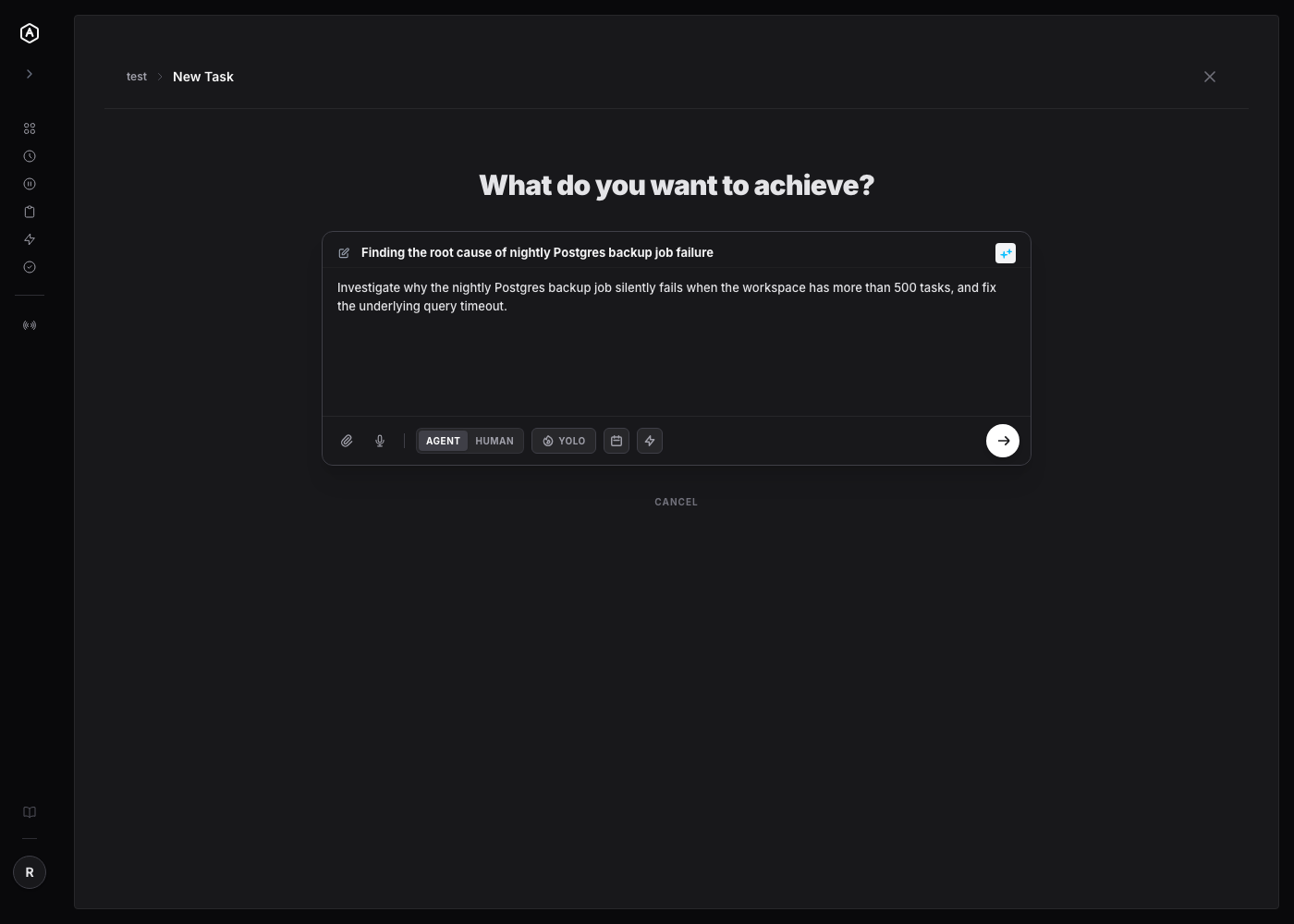
AgentRQ's task composer now does this for you. Type your description, click the sparkle icon, and a title appears — generated by a language model running entirely inside your browser tab.
What's Actually Running
There's no API call here. The title generator is Xenova/LaMini-Flan-T5-248M, a 248-million-parameter instruction-tuned model, loaded through @huggingface/transformers and run as WebAssembly inside a dedicated Web Worker — off the main thread, so typing and scrolling stay smooth while it works.
The prompt is simple and deliberately constrained:
It's called with max_new_tokens: 15, a low temperature of 0.3 for deterministic output, and a repetition_penalty of 1.2. The result gets a quick cleanup pass to strip common model artifacts — things like a leading "Title: " or stray quotation marks — before it lands in the title field.
Private by Construction
Because the model runs on-device, your task description is never sent anywhere to generate a title. No request leaves the browser, no third-party inference API sees your text. For teams putting internal infrastructure details, customer data, or anything sensitive into task descriptions, that's not a minor detail — it's the difference between a feature you can actually use and one your security team vetoes.
How It Behaves
The sparkle button only shows up once your description is at least 5 characters long, and only in browsers that support both Web Workers and WebAssembly — there's no broken button dangling in unsupported environments.
The first click triggers a one-time model download, and you'll see a live progress indicator (Loading AI Model... 61%) while it fetches. After that, the model is cached by the browser and generation is fast on every subsequent task.
If you've already typed your own title, AgentRQ won't clobber it — the generator only fills in the title field automatically until you've edited it yourself, at which point it steps back and leaves your text alone.
Why a Small Model
At 248M parameters, this model is tiny by modern LLM standards — and that's exactly the point. It's small enough to download once and run in WASM on an ordinary laptop without turning your fan on, while still being capable enough to turn "investigate why the nightly Postgres backup job silently fails when the workspace has more than 500 tasks, and fix the underlying query timeout" into something like "Finding the root cause of nightly Postgres backup job failure" — accurate, short, and usable as-is.
It's a small feature, but it's the kind of detail that adds up: one less thing to type, and one less place where your task data has to leave your machine to get useful.
---
AgentRQ is currently in public beta. Join our GitHub community to help shape the future of human-agent collaboration.