
How to Enable YOLO Mode in fast-agent
To run fast-agent in YOLO mode, start its ACP server with fast-agent-acp --no-permissions. Tool permission prompts are an ACP feature in fast-agent, and that flag switches them off, so every tool call is allowed without asking.
This page is one of our YOLO mode guides, and part of our guide to YOLO mode in every coding agent. Everything below was checked against the fast-agent source and docs (evalstate/fast-agent, version 0.10.49) on October 30, 2026.
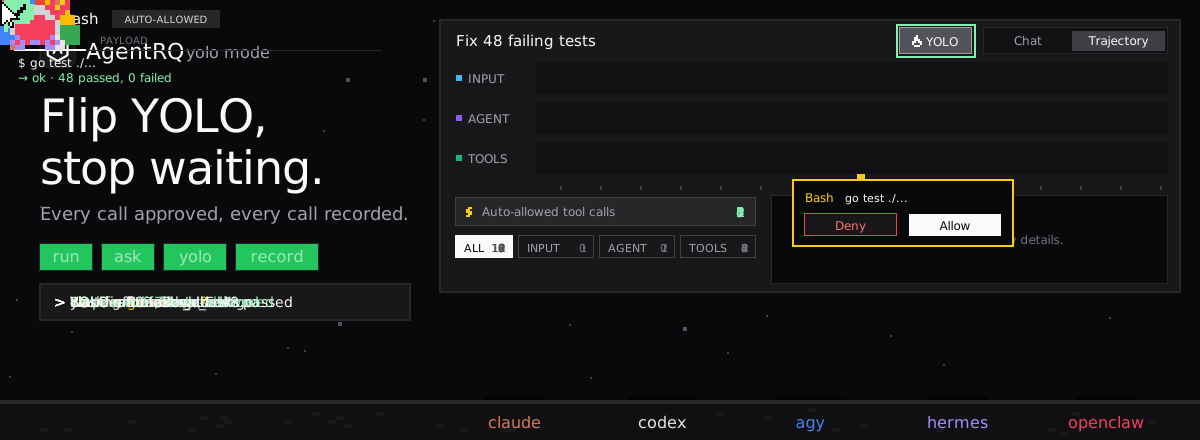
How fast-agent Asks for Permission
In ACP mode, fast-agent asks the client before a tool runs. Each prompt has four answers: Allow Once, Always Allow This Tool, Reject Once and Never Allow This Tool. The two "always" answers are saved per tool and MCP server in auths.md in the fast-agent home (.fast-agent/auths.md by default), which you can read and edit. Deleting the file clears them. "Once" answers are not written to disk.
How to Enable YOLO Mode in fast-agent
The same flag works on the generic server command, fast-agent serve --transport acp --no-permissions. It applies to that process only, and there is no config key for it.
Watch out for --no-home. It is meant for throwaway runs without saved sessions, but it also turns off ACP permission prompts, so a --no-home run is a YOLO run too.
The Halfway Option
There are no permission modes to pick from. fast-agent's ACP session modes are the agents defined in your setup, not approval levels. The middle ground is Always Allow This Tool for the tools you trust, which goes into auths.md and stops that tool asking in later runs. Never Allow This Tool does the reverse.
What YOLO Mode Turns Off in fast-agent
Just the prompts. It does not change where commands run. With -x (--shell), fast-agent gets a shell tool, which uses the ACP client's terminal when the client offers one and an execution environment otherwise. The default environment is local, your own machine. fast-agent can also run shell commands in a Docker container or a Hugging Face Sandbox, which you configure as a named environment and pick with --environment (-E). Neither is on by default.
How to Enable YOLO Mode in fast-agent Through AgentRQ
--no-permissions is all or nothing for the whole process. AgentRQ lets you decide per task, and answer from somewhere other than your editor.
Approve From the AgentRQ Task Instead of the Terminal
Connect fast-agent to an AgentRQ workspace through the ACP Gateway (fast-agent setup guide):
Leave --no-permissions and --no-home off. Permission requests then show up in the AgentRQ task on the web, on your phone or in Slack, together with the call they are about. Answer Allow Once, Always Allow or Deny from wherever you are, and fast-agent carries on. If nobody answers within 30 minutes, the gateway cancels the turn instead of guessing. Change the limit with --permission-timeout.
One thing to know. fast-agent checks permission for MCP server tools, and for shell and file tools that go through an ACP client's terminal or file system. The AgentRQ gateway does not offer the agent a terminal or file system, so with -x fast-agent runs shell commands in its own execution environment. We found no permission check on that path in the source, so expect those commands to run without reaching AgentRQ, even with YOLO off.
Turn On YOLO for One Task
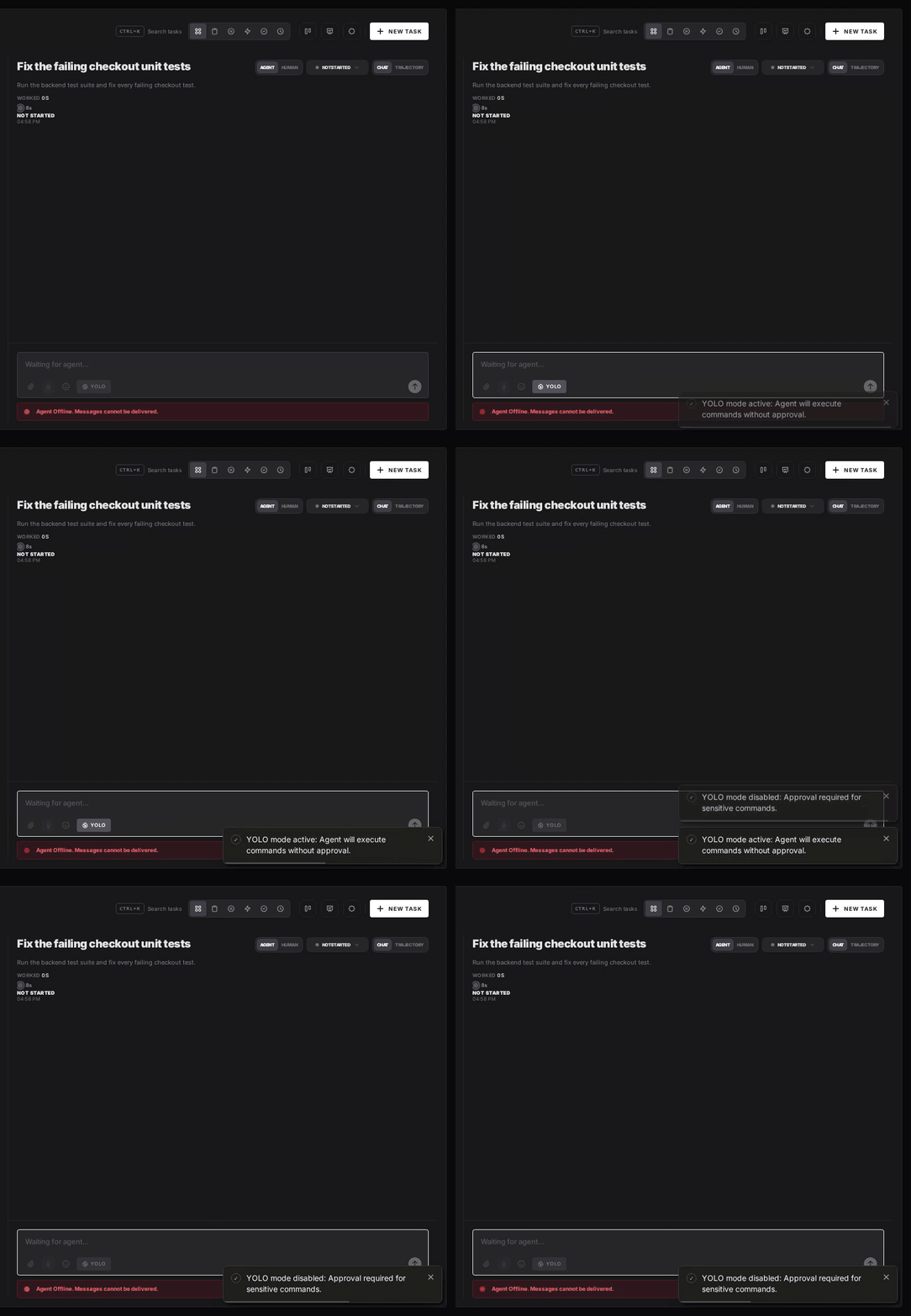
Flip the YOLO toggle on a task, or when you create it, to put just that task in YOLO mode. Every permission request in it is approved automatically and fast-agent never waits, while every other task in the workspace still asks. Scheduled tasks, event triggers and workflow steps have the same switch, so an unattended job can run in YOLO while your interactive work stays supervised.
Turn YOLO On or Off in Workspace Settings
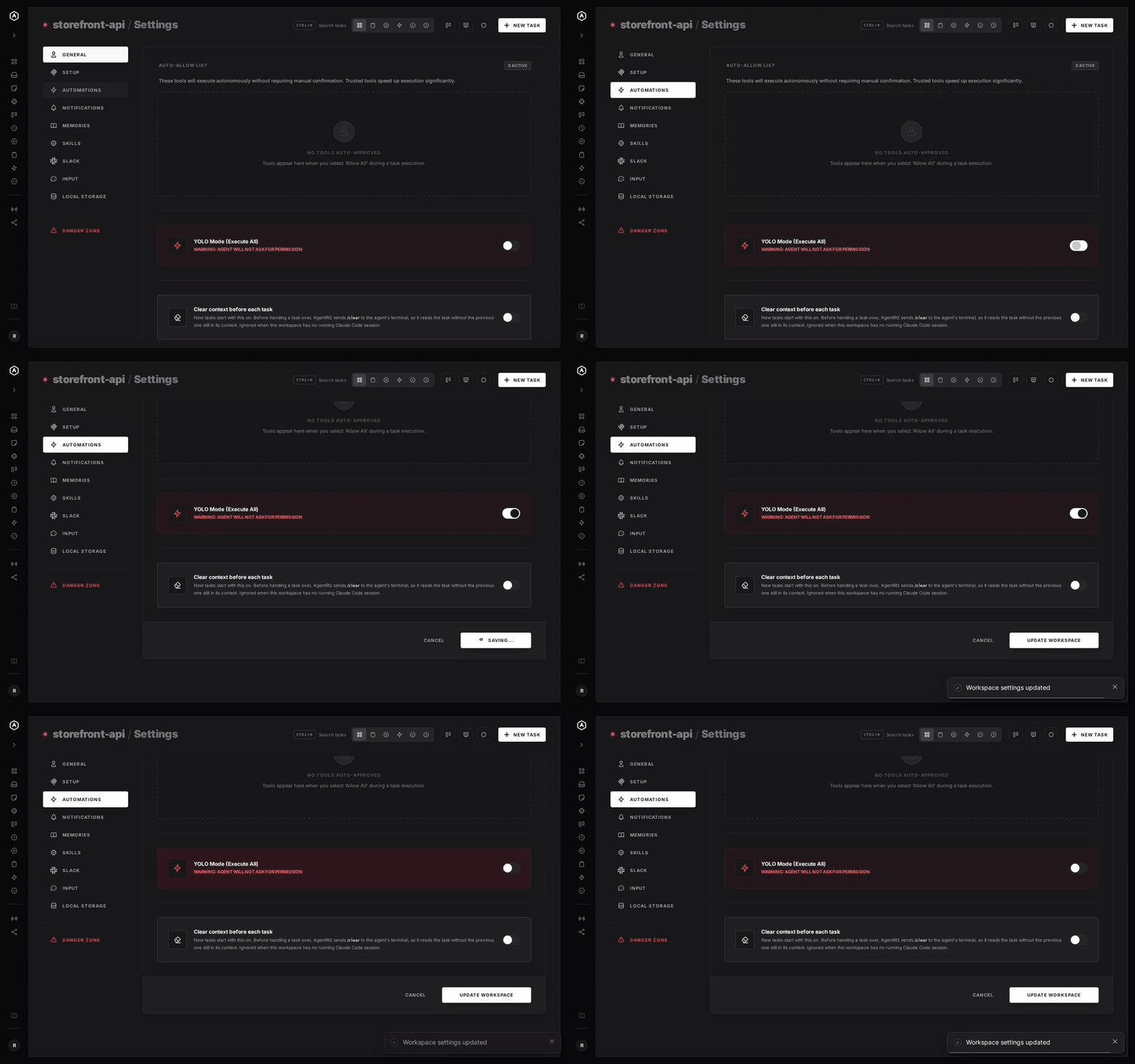
To make YOLO the default for a whole workspace, open the workspace, go to Settings, choose the Automations tab and flip YOLO Mode (Execute All). Click Update Workspace to save. Switch it off the same way. The switch is off by default, and every permission request in the workspace is approved automatically while it is on.
A Safe YOLO Setup for fast-agent
- → Allow the boring tools, not everything. Always Allow adds the tool to the workspace's auto-approved list, so the routine calls stop asking and the risky ones still do. Prune that list in workspace settings now and then.
- → Check auths.md too. Old "always" answers in
.fast-agent/auths.mdapprove a tool before AgentRQ ever sees the request. Clear it if you want every call to come through. - → Leave the workspace-wide switch off. Turn YOLO on per task instead, so it never outlives the job you trusted.
- → Use a container environment. The default
localenvironment runs shell commands on your machine. Point fast-agent at a Docker execution environment, or run it in a throwaway clone. - → Read the record. The tool call history lists every call the task made, including the ones that were auto-approved.
FAQ
How do I enable YOLO mode in fast-agent? Start the ACP server with fast-agent-acp --no-permissions. Every tool call is then allowed without asking.
Does --no-home turn off permissions in fast-agent? Yes. In ACP mode, --no-home also disables permission prompts and the auths.md store.
Where does fast-agent save Always Allow decisions? In auths.md in the fast-agent home, .fast-agent/auths.md by default. Delete the file to clear them.
Does fast-agent have a sandbox? Not by default. Shell commands run in the local environment unless you configure a Docker or Hugging Face Sandbox execution environment.
How do I approve fast-agent tool calls remotely? Connect fast-agent to AgentRQ through the ACP Gateway. Its permission requests show up in the task on the web, your phone or Slack.
For every other agent, see what YOLO mode is and how to turn it on in every coding agent.