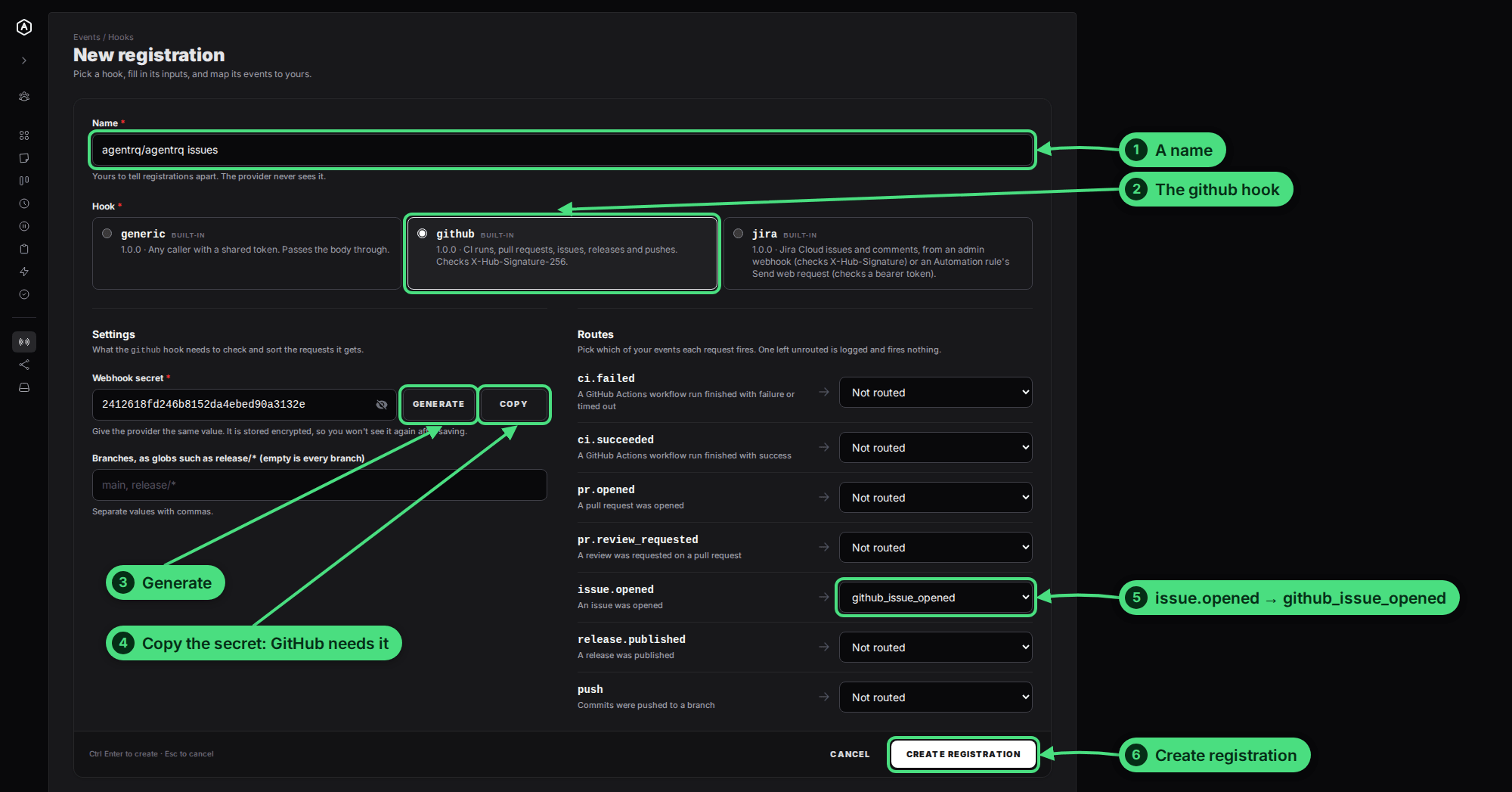
Register a hook, route its events to yours, copy the URL into the service.
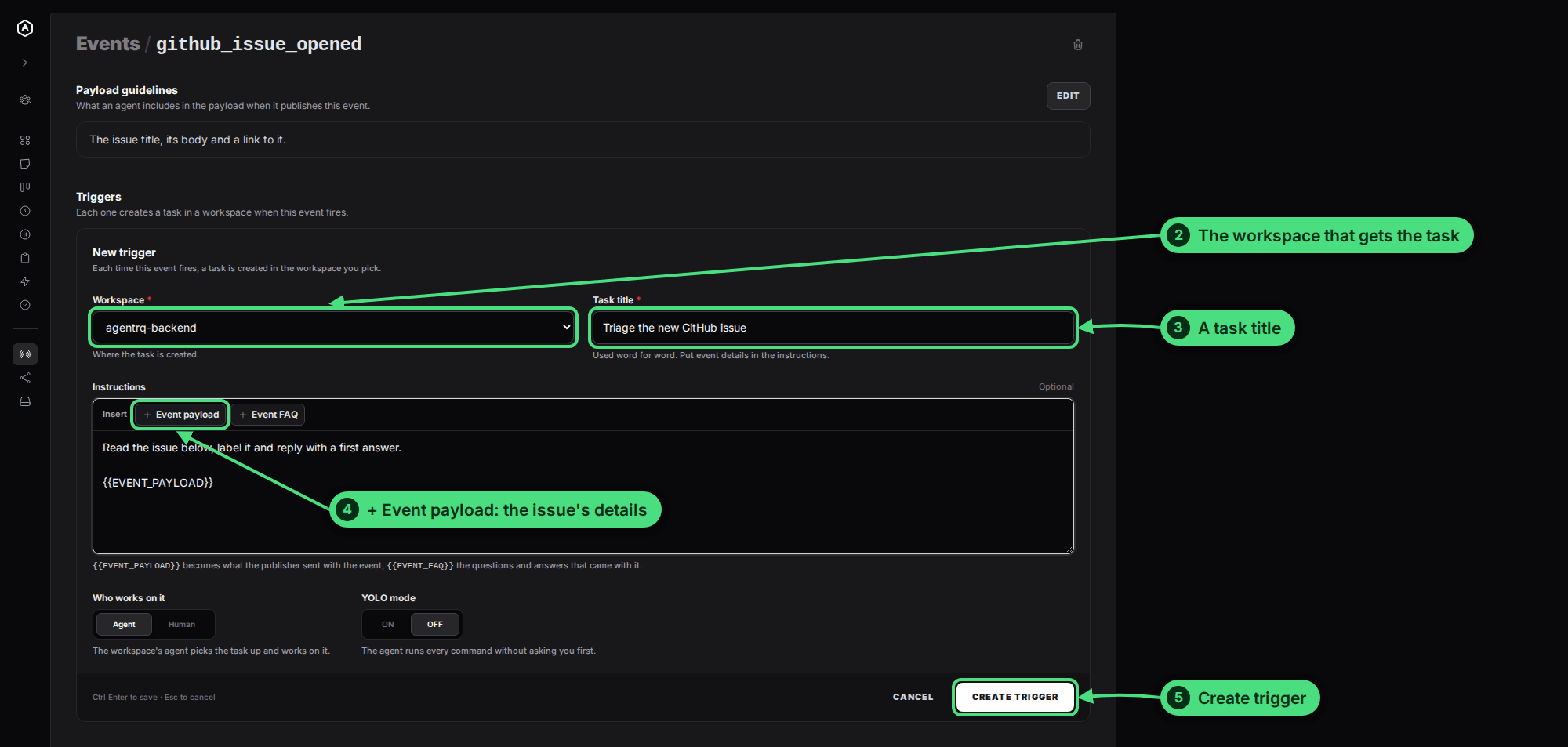
The built-in github hook checks GitHub's signature and fires an event for each thing you route. Route one to an event whose trigger files a task, and the agent in that workspace gets the issue, pull request or run in its instructions. Set it up step by step.
Jira rule: Send to AgentRQ
  Trigger   Manual trigger from work item
  Action    Send web request
  URL       the registration's payload URL
  Method    POST
  Body      Work item data (Jira format)
  Header    Authorization: Bearer <secret>

AgentRQ event: jira.issue.sent
  task gets: key, summary, link, description
A Jira Automation rule adds Send to AgentRQ to your issues, or a Jira webhook fires when an issue is created, updated or commented on. The task gets the issue's key, summary, link and description. Set it up step by step.
The generic hook checks a shared token and passes the request body through as the event's payload. A CI step, a monitoring alert, a cron job or an internal form can all give an agent a task. Set it up step by step.
curl -X POST "$HOOK_URL" \
  -H "Authorization: Bearer $HOOK_SECRET" \
  -H 'Content-Type: application/json' \
  -H "Idempotency-Key: $CI_RUN_ID" \
-d '{"job": "nightly-backup", "status": "failed"}'An outside service can hand out work without handing out your machines.
Every hook checks a secret, and the payload URL carries a token. Rotate replaces it and the old URL stops working at once.
An event left Not routed is ignored. A route to a trigger with YOLO mode on is marked with a warning.
Deliveries shows each request as published, ignored, rejected, duplicate or failed, with the reason. Replay runs a failed one again.
Which coding agents take tasks from Slack, GitHub or Jira? See our comparison, and the Dependabot alerts walkthrough.